South Korea Aims for Global AI Leadership with NVIDIA Partnership and KAIST Research Lab

South Korea is strategically positioning itself as a global powerhouse in artificial intelligence, marked by a high-level delegation led by President Jae Myung Lee and a consortium of the nation’s leading business figures and researchers. Convening at the AI Summit in San Francisco, this pivotal gathering with NVIDIA and its extensive ecosystem partners signals a decisive push to amplify South Korea’s AI infrastructure and cultivate a world-class talent pool. This initiative builds directly upon NVIDIA founder and CEO Jensen Huang’s recent visit to South Korea, underscoring a sustained commitment to advancing the nation’s AI ambitions. The discussions and subsequent announcements at the summit are designed to accelerate South Korea’s comprehensive, full-stack approach to AI development, aiming to solidify its status as a vanguard of AI innovation on the international stage.
The cornerstone of this accelerated progress was revealed with the announcement of a groundbreaking joint AI research lab, established through a collaboration between NVIDIA and the Korea Advanced Institute of Science and Technology (KAIST). Located at the KAIST Kim Jaechul Graduate School of AI in Seoul, this lab is specifically dedicated to advancing agentic AI for South Korea. This partnership represents a significant milestone, being the first such joint AI lab forged between a Korean university and any global technology company. The synergistic endeavor is poised to establish a formidable academic AI research program, integrating NVIDIA’s extensive full-stack AI expertise, including its cutting-edge NVIDIA Nemotron open models and NVIDIA AI Cloud partner computing capabilities, with the unparalleled scientific acumen of KAIST, a distinguished institution renowned for its leading research across Asia. Further updates from the summit, including details on President Lee’s engagements with Mr. Huang and other key business leaders from both South Korea and the United States, are anticipated as the event progresses.
Deepening Ties: A Chronology of Collaboration
The strategic alignment between South Korea and NVIDIA has been steadily strengthening, with recent engagements highlighting a shared vision for AI advancement. The AI Summit in San Francisco serves as a culmination of these ongoing dialogues and a launchpad for future initiatives.
June 2024: Foundation for Expanded Collaboration
Leading up to the San Francisco summit, significant announcements in June laid the groundwork for the current strategic push. NVIDIA and SK Group, a major South Korean conglomerate, solidified their long-standing partnership with an expanded collaboration focused on co-developing advanced memory solutions. This agreement specifically targets the creation of memory technologies crucial for NVIDIA’s next-generation platforms, encompassing critical areas such as AI infrastructure, personal AI, and physical AI. This move is vital, as the demand for high-bandwidth, low-latency memory is a fundamental bottleneck in scaling AI workloads.
Concurrently, SK Telecom, another prominent SK Group affiliate, unveiled its ambitious plans to construct extensive AI infrastructure. This initiative is designed to serve as the backbone for South Korea’s burgeoning innovation in physical AI, robotics, and other advanced AI applications. The development of such robust infrastructure is essential for South Korea to translate its research and development into tangible, real-world AI solutions.
July 23, 2024 (Evening PT): Pre-Summit Gathering
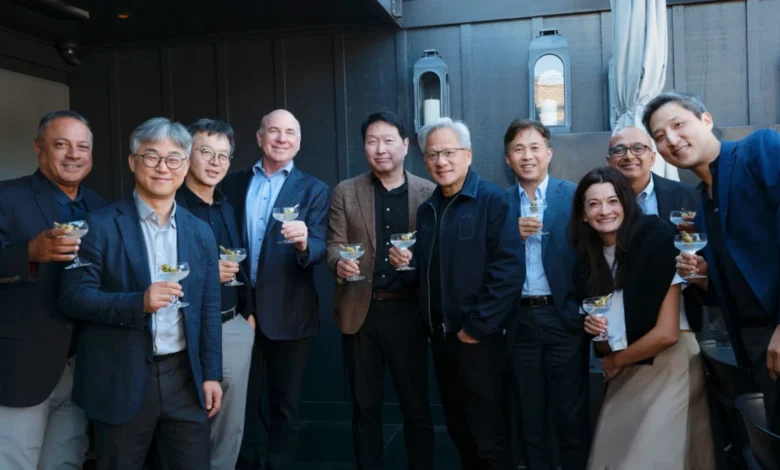
The evening before the official commencement of the AI Summit, NVIDIA founder and CEO Jensen Huang hosted SK Group Chairman Chey Tae-won and representatives from SK Hynix and SK Telecom for a dinner in Woodside, California. This gathering, set against the backdrop of Silicon Valley, symbolized the robust and enduring partnership between NVIDIA and the SK companies. The discussions likely centered on further aligning their strategies and exploring new avenues for collaboration in the rapidly evolving AI landscape. The presence of SK hynix, a leading global semiconductor supplier, is particularly noteworthy, given the critical role of advanced memory in powering AI systems.
July 24, 2024 (Summit Day): Joint Research Lab Announcement
The AI Summit officially kicked off with a significant announcement: the establishment of the joint AI research lab between NVIDIA and KAIST. This partnership marks a significant investment in foundational AI research, specifically targeting agentic AI – AI systems capable of autonomous decision-making and action. The lab’s focus on agentic AI is strategic, as this field is seen as crucial for developing more sophisticated and capable AI applications across various sectors, from advanced robotics to personalized services.
Strategic Imperatives: South Korea’s AI Ambitions
South Korea’s pursuit of AI leadership is not merely aspirational; it is driven by a clear set of strategic imperatives designed to secure its economic future and technological sovereignty. The nation has consistently demonstrated a strong aptitude for technological innovation, particularly in areas like semiconductors, telecommunications, and manufacturing. By focusing on AI, South Korea aims to leverage these existing strengths and address future challenges.
Economic Diversification and Growth: The global AI market is projected to experience exponential growth. South Korea, with its strong industrial base and skilled workforce, is well-positioned to capture a significant share of this market. AI integration promises to enhance productivity across existing industries, such as automotive, shipbuilding, and electronics, while also fostering the creation of entirely new AI-centric industries. According to recent market analyses, the global AI market is anticipated to reach trillions of dollars in the coming decade, with significant opportunities in areas like AI-powered automation, predictive analytics, and intelligent systems.
Technological Sovereignty and Competitiveness: In an era where AI is increasingly seen as a critical national security and economic asset, developing indigenous AI capabilities is paramount. Reliance on foreign AI technologies can create vulnerabilities. South Korea’s investment in AI research and infrastructure aims to reduce this dependency and ensure its competitiveness on the global stage. The focus on developing advanced AI models, like those enabled by NVIDIA’s Nemotron, and fostering an ecosystem of AI startups is key to this objective.
Addressing Societal Challenges: AI offers powerful tools for addressing some of South Korea’s most pressing societal issues. These include an aging population, which can be supported by AI-driven healthcare and elder care solutions; environmental sustainability, through AI-optimized resource management; and enhanced public services, via AI-powered smart city initiatives.
The NVIDIA Ecosystem: A Catalyst for Innovation
NVIDIA’s role in South Korea’s AI ascent is multifaceted, extending beyond the provision of hardware. The company’s comprehensive "full-stack" approach encompasses hardware (GPUs), software (CUDA, AI frameworks), and cloud services, creating a potent ecosystem for AI development.
Hardware Prowess: NVIDIA’s dominance in high-performance computing, particularly its Graphics Processing Units (GPUs), is foundational to modern AI. These processors are essential for training and deploying complex AI models, offering parallel processing capabilities that far surpass traditional CPUs. The demand for GPUs in AI research and deployment is staggering; the global AI chip market, largely driven by GPUs, is projected to exceed $200 billion by 2027.
Software and Frameworks: NVIDIA’s software stack, including the CUDA parallel computing platform and its partnerships with leading AI frameworks like TensorFlow and PyTorch, significantly lowers the barrier to entry for AI development. This allows researchers and developers to leverage NVIDIA’s hardware efficiently.
Cloud and Partner Computing: The NVIDIA AI Cloud provides scalable computing resources and access to pre-trained models and development tools, democratizing AI access for businesses and research institutions. Furthermore, NVIDIA’s extensive network of ecosystem partners, ranging from semiconductor manufacturers to cloud service providers and software developers, creates a synergistic environment where innovation can flourish. The collaboration with SK Hynix for advanced memory, for example, directly addresses a critical component of the AI hardware supply chain.
KAIST: A Beacon of Research Excellence
The partnership with KAIST is strategically vital for South Korea’s AI ambitions. KAIST is consistently ranked among the top science and technology universities globally, boasting a strong track record in artificial intelligence research.
Agentic AI Focus: The joint lab’s emphasis on agentic AI is particularly forward-looking. Agentic AI refers to systems that can perceive their environment, make decisions, and take actions to achieve specific goals with a degree of autonomy. This is a critical area for developing AI that can operate in complex, real-world scenarios, such as autonomous vehicles, advanced robotics, and sophisticated decision-support systems. The development of agentic AI is expected to unlock new levels of automation and intelligence across industries.
Talent Development: The collaboration will not only foster cutting-edge research but also cultivate a new generation of AI talent. By providing students and researchers with access to NVIDIA’s state-of-the-art technology and expertise, KAIST can ensure that its graduates are equipped with the skills needed to drive South Korea’s AI future. This includes training in areas like large language models, generative AI, and reinforcement learning, all of which are integral to agentic AI development.
Academic-Industry Synergy: The establishment of this joint lab creates a unique bridge between academia and industry. This synergy allows for fundamental research discoveries to be rapidly translated into practical applications, accelerating the pace of innovation and commercialization. This model has proven effective in fostering technological breakthroughs and driving economic growth.
Broader Implications for the Global AI Landscape
The concerted effort by South Korea, in partnership with NVIDIA and its academic institutions, carries significant implications for the global AI landscape.
Increased Competition and Innovation: This initiative intensifies the global competition in AI development. As South Korea strengthens its capabilities, it will likely drive further innovation from other nations and companies seeking to maintain their competitive edge. This healthy competition can lead to faster advancements in AI technology for the benefit of all.
Democratization of Advanced AI: By establishing a robust AI ecosystem and fostering open research initiatives, South Korea and NVIDIA are contributing to the broader democratization of advanced AI. This means that more organizations and researchers worldwide will have access to the tools and knowledge needed to develop and deploy AI solutions.
Shaping Future AI Standards: As South Korea emerges as a leader in specific AI domains, particularly agentic AI, its approaches and best practices could influence the development of future international AI standards and regulations. This could have a long-term impact on how AI is developed, deployed, and governed globally.
Resilience in the Supply Chain: The collaboration with SK Hynix highlights the strategic importance of securing and advancing the AI hardware supply chain. Diversifying and strengthening these critical links is essential for global AI stability and growth, especially in light of geopolitical considerations and the increasing demand for AI chips.
The AI Summit in San Francisco, with its focus on high-level partnerships and tangible research initiatives like the NVIDIA-KAIST joint lab, signifies a pivotal moment in South Korea’s journey to become a global AI leader. The nation’s strategic investment in infrastructure, talent, and cutting-edge research, amplified by collaborations with industry giants like NVIDIA, positions it to make significant contributions to the future of artificial intelligence. The world will be watching to see how these initiatives translate into groundbreaking innovations and solidify South Korea’s standing in the rapidly evolving AI arena.
Related posts: